Let’s be honest. When the HR team announces the next team building activity, a familiar groan echoes through the office. Laser tag again? Another “motivational” workshop that everyone forgets by Monday morning?
But here’s what’s quietly changing across Malaysian corporates: the most talked-about, most re-booked, and most genuinely enjoyed team building activities for Malaysian companies are turning to isn’t an outdoor obstacle course or a virtual quiz night — it’s cooking.
Yes, cooking.
And before your team rolls their eyes, read on. Because what happens inside a professional kitchen during a cooking team building session in Malaysia looks nothing like what people expect — and that’s precisely why it works.
Why Teams Often Overlook Cooking as a Team Building Activity in Malaysia
The knee-jerk reaction is understandable. When most people picture a cooking class, they imagine standing at a counter, quietly chopping vegetables while a chef narrates from the front. It sounds more like a hobby class than a corporate team building experience in Malaysia.
This misconception is exactly why so many teams dismiss it — and exactly why they’re missing out.
The truth is, cooking-as-team-building has very little in common with a cooking-as-hobby. One is passive. The other is high-stakes, fast-paced, and surprisingly revealing about how your team truly functions under pressure.
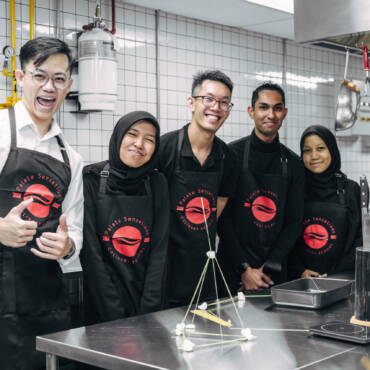
Palate Sensations Team Building Malaysia was founded with a singular insight: food is a unifying language. When people gather around a common goal — and that goal ends in a meal they’ve built together — something genuinely powerful happens. Barriers drop. Hierarchies blur. People show up as people, not just job titles.
Established in Singapore in 2005 and expanding to Malaysia in April 2023, Palate Sensations brings nearly two decades of refined corporate culinary experience to Klang Valley — designed specifically for teams, not tourists.
Not a Cooking Class — A Team Challenge: The Real Difference That Changes Everything
This is the most important distinction to make, and it’s worth stating clearly: Palate Sensations doesn’t run cooking classes. They run team challenges that happen to involve cooking.
The difference is everything.
In a traditional cooking class, you follow instructions step by step, and success is measured individually. In a cooking competition team building format, your team is handed a challenge — a brief, a set of ingredients, a time limit, and a judging panel — and you must figure out the rest together.
At Palate Sensations, challenge formats include:
- The Sushi Battle — Creative interpretation meets culinary execution.
- The Pizza Challenge — Strategy, flavour, and presentation all on the line.
- The Nasi Challenge — Explore the diversity of Malaysian rice culture across 10 plus variations.
- The Laksa Battle — Navigate 9 types of Malaysian laksa and choose your team’s weapon.
- Mystery Box – Using a box of mystery ingredients, create dishes to suit a theme.
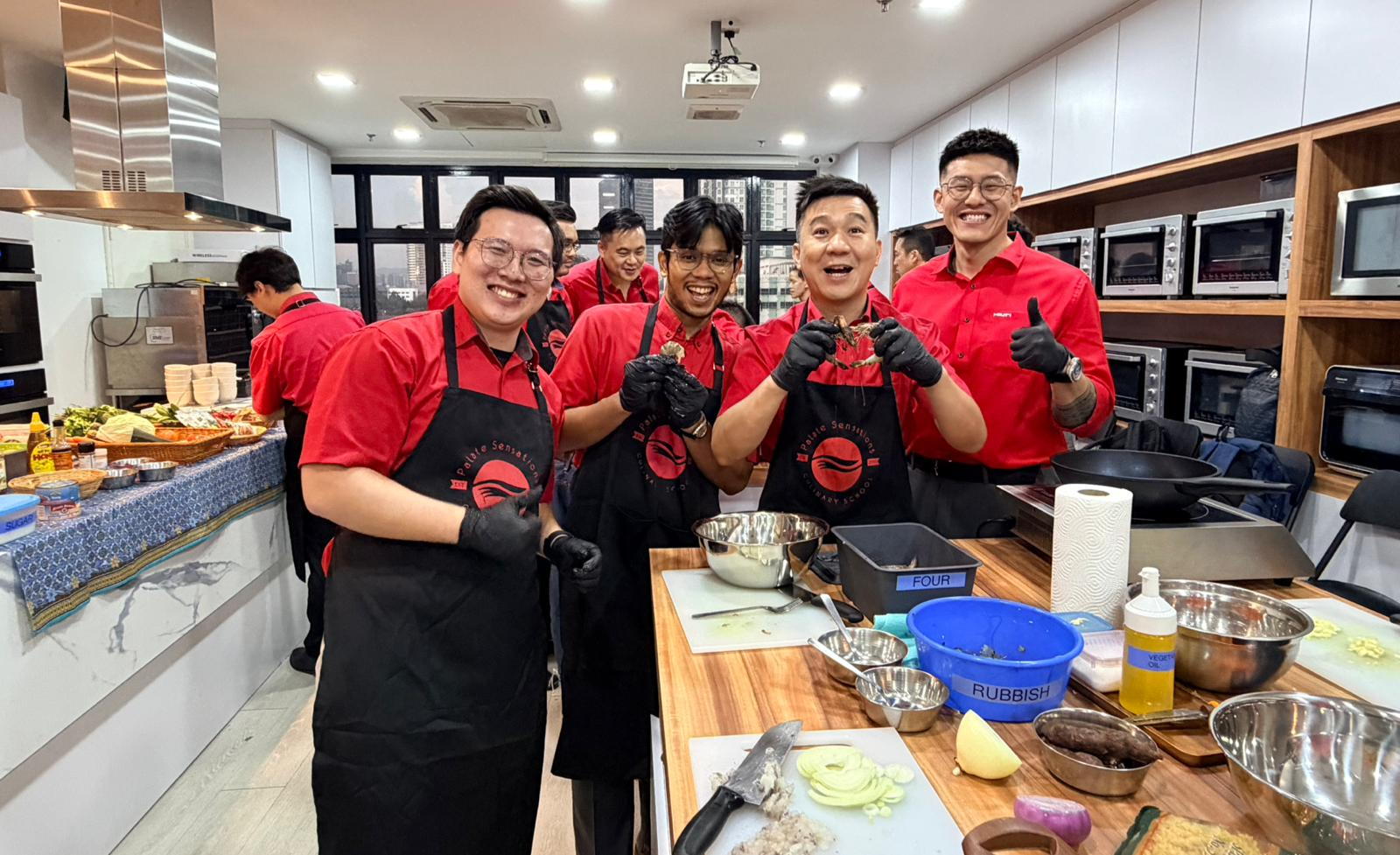
Each format requires teams to search for recipes, design branding for their dish, set pricing, present to judges, and defend their product — all within approximately three hours. That’s not a cooking class. That’s a hands-on team building experience in Malaysia that mirrors the real dynamics of your workplace.
 Why Cooking Team Building Builds Stronger Teams: Communication, Roles, and Real-Time Coordination
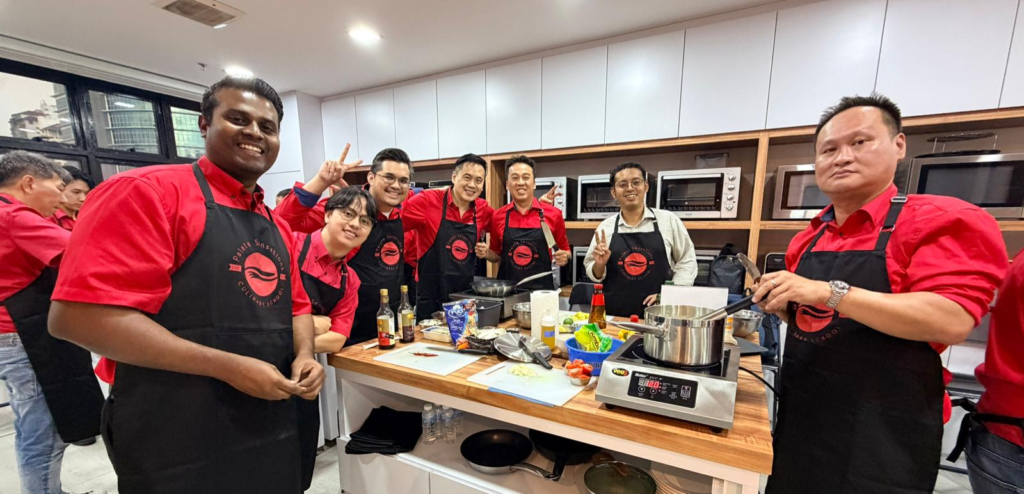
Here’s where the science meets the saucepan. Cooking under pressure — as a team — naturally triggers the exact behaviours that Learning & Development (L&D) teams spend budgets trying to cultivate in boardrooms.
Think about what a professional kitchen demands:
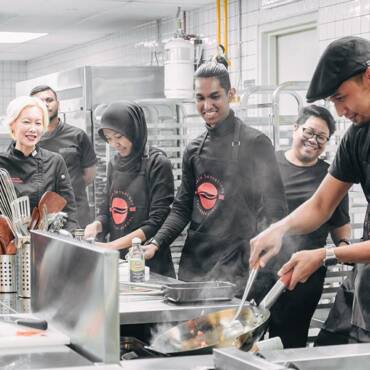
Clear, immediate communication — There’s no time for email chains or passive-aggressive Slack messages. You talk, you listen, you adjust.
Role clarity — Someone leads, someone executes, someone quality-checks. These roles often emerge organically, and they reveal a lot.
Real-time problem solving — An ingredient is missing. The timer is running. What does your team do?
Accountability without blame — When a dish doesn’t go to plan, the team recalibrates together rather than pointing fingers.
Palate Sensations’ programmes are specifically designed to deliver measurable HR and professional development outcomes, including:
- Time management
- Decision making under stress
- Task prioritisation
- Leadership and executive presence
- Multi-tasking and coordination
- Creative thinking
- Marketing and presentation skills
These aren’t accidental by-products — they’re engineered into every session by a team of professional chef-facilitators who are also trained in team dynamics. The founder, Lynette Foo, brings both Le Cordon Bleu culinary training and over a decade of corporate world experience to the design of every programme. That dual background is rare — and it shows.
Perfect for Mixed Personalities: How Introverts and Extroverts Both Thrive in a Kitchen Setting
One of the most common concerns HR managers raise is this: “Our team has a mix of personality types. Will everyone actually participate?”
It’s a fair question. Most team bonding activities results in companies defaulting to reward the loudest voices — outdoor games, icebreaker games that feel more like auditions, competitive formats that favour the extroverted.
A kitchen is different.
A kitchen has roles for every personality type:
- The quiet, detail-oriented team member naturally gravitates toward precision tasks — plating, measuring, quality checking.
- The natural leader steps into coordination — managing the timeline, delegating tasks, communicating with the judging panel.
- The creative thinker drives the concept — what story does this dish tell? How do we make it stand out?
- The communicator handles the pitch — presenting to the judges and selling the dish.
Nobody gets left in the corner. Nobody is forced to do a trust fall or hold a microphone in front of 50 colleagues. The kitchen provides structured roles that allow every individual to contribute in a way that aligns with their strengths.
Palate Sensations also opens every session with icebreaker games designed to dissolve initial social barriers before the cooking begins — creating a warm, energised atmosphere that even the most reserved team members can ease into.
What Happens in a Cooking Team Building Session (Step-by-Step Experience)
Wondering what a session actually looks like from arrival to applause? Here’s a walkthrough of a typical cooking team building experience at Palate Sensations:
Step 1: Welcome and Icebreakers
Teams arrive at the state-of-the-art, air-conditioned kitchen studio in Damansara Intan, Petaling Jaya. The session opens with facilitator-led icebreaker games to set the tone — fun, energised, and low-pressure.
Step 2: Programme Brief and Team Formation
Teams are divided and assigned their challenge format. Each group receives their brief — which may include a mystery ingredient list, a menu category, a target audience, and a budget to work within.
Step 3: Planning Phase
Teams must strategise before they cook. Who does what? What’s the recipe? What’s the story behind the dish? This is where leadership and communication patterns begin to surface.
Step 4: Hands-On Cooking
The kitchen comes alive. Teams cook, taste, adjust, and plate — all against the clock. Professional chef-facilitators circulate to guide technique while also observing team dynamics.
Step 5: Presentation and Judging
Each team presents their dish to the judges — explaining their creative concept, pricing strategy, and branding. This is where the marketing and communication objectives come into full play.
Step 6: Tasting, Celebration and Debrief
Teams enjoy the food they’ve created together, celebrate their wins, and — as a bonus — professional chefs bring out desserts prepared in-house. The session typically wraps with a facilitated debrief, connecting the in-kitchen experience to real workplace behaviours.
Total duration: approximately 3 hours, start to finish.
How to Make It More Appealing in Malaysia: Themes, Competition Formats, and Outcome-Based Goals
One reason company team building planners in Malaysia keep returning to Palate Sensations is the sheer flexibility of the format. This isn’t a one-size-fits-all programme. It’s a fully customisable experience built around your team’s specific objectives.
Competition Formats Available:
- The Mystery Box Challenge is best for large mixed teams and activates creativity, speed, and presentation skills.
- The Cooking Class suits new teams or onboarding situations and builds collaboration and communication.
- The Baking Challenge appeals to creative or design teams and emphasises precision and planning.
- The Bake For A Cause works for CSR-focused events and develops empathy, purpose, and teamwork.
- The Murder Mystery Dinner engages analytical thinkers and develops problem solving and communication.
Locally relevant themes bring Malaysian cultural pride into the kitchen — from mastering the perfect laksa to competing over the best nasi dish. This cultural connection makes the experience immediately meaningful for local and regional teams alike.
Outcome-based goals allow HR and L&D managers to tailor the session to specific KPIs. Choose your learning objective — planning and cooperation, teamwork and creativity, or leadership and cooperation — and the programme is structured accordingly.
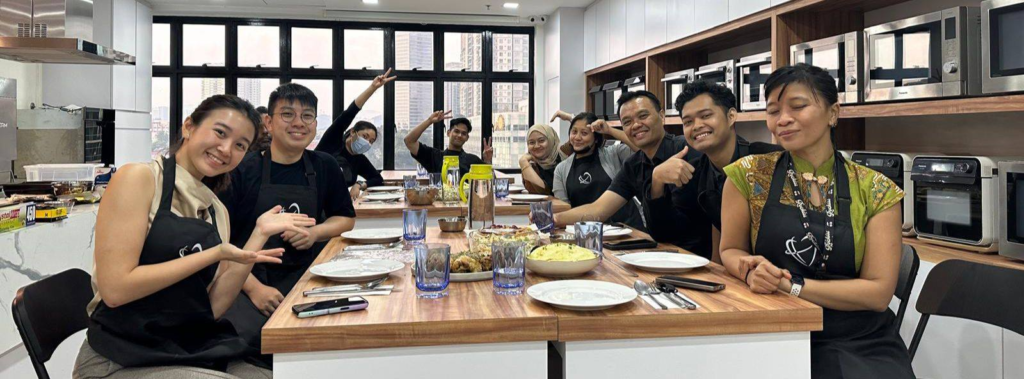 Who It’s For: Corporate Teams, Leadership Offsites, New Teams, and Company Celebrations
Cooking team building experiences in Malaysia at Palate Sensations are designed for a wide range of team contexts:
- Corporate departments looking for a memorable mid-year or year-end team activity.
- Leadership teams running offsite retreats where real decision-making dynamics need to surface.
- Newly formed teams or post-merger groups that need to build trust quickly.
- Company anniversaries and milestone celebrations that want to mix meaningful bonding with genuine fun.
- Regional teams visiting Malaysia who want an experience that’s culturally immersive and professionally relevant.
- HR and L&D professionals who need an activity that maps to specific development objectives.
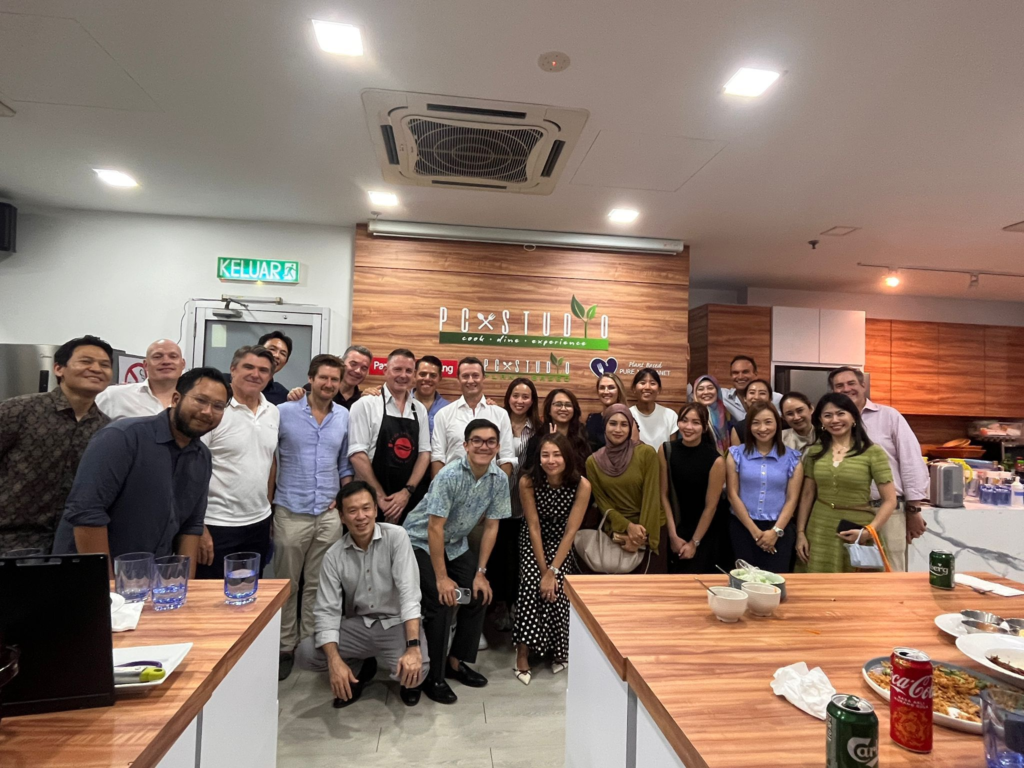
The facility accommodates up to 40 participants in a fully air-conditioned, pork-free and lard-free professional kitchen environment at Damansara Intan, Petaling Jaya — making it suitable for mid-sized corporate groups without the logistical headache of external venues.
Palate Sensations also offers flexible, customisable menus and budgets, and can accommodate a range of dietary requirements — including halal and vegetarian needs — ensuring nobody is left out.
Next Steps: Plan a Cooking Team Building Event in Malaysia That Your Team Will Actually Enjoy
Here’s the thing about hands-on team building Malaysia activities that use cooking as the vehicle: the proof is always in the eating.
Teams that walk in sceptical walk out talking about it at the next Monday stand-up. They reference the moment someone unexpected took charge of the plating. They laugh about the laksa that nearly didn’t make the judging table. They remember — genuinely remember — the experience in a way that no slideshow presentation or corporate workshop ever quite manages.
That’s the power of shared experience. And shared food? That’s one of the oldest and most effective human bonding mechanisms in existence.
Palate Sensations Team Building Malaysia has spent nearly two decades refining the art of turning a kitchen into a leadership laboratory, a communication workshop, and a celebration all at once — without ever making it feel like work.
Ready to plan your next corporate cooking team building Malaysia event?
Visit www.palateteambuildingmalaysia.com to explore programmes, formats, and availability — or reach out directly and the team will get back to you within one business day.
Your team deserves more than another generic team building day. Give them something they’ll actually talk about.
 Frequently Asked Questions
Why is cooking team building effective for workplace teams?
Cooking under time pressure as a group forces exactly the behaviours that great teams need — clear communication, rapid decision-making, role clarity, and real-time problem solving. Unlike passive workshops, a cooking team building session puts those dynamics into live action. What surfaces in the kitchen often mirrors what happens in the office — and that’s precisely what makes it such a powerful development tool.
What if my team thinks they don’t like cooking — will they still enjoy it?
Absolutely. The majority of participants at Palate Sensations arrive unsure — and leave as converts. The reason: they quickly discover it’s not about being a good cook. It’s about working together under a shared challenge. The cooking is the medium; the teamwork is the message. Even self-declared non-cooks have walked away saying it was the best team bonding activity Malaysia they’ve ever done.
Do participants need cooking experience to join?
Not at all. Palate Sensations’ programmes are designed to be inclusive regardless of culinary skill level. Professional chef-facilitators are on hand throughout every session to guide technique and ensure everyone feels competent and confident. The focus is always on team dynamics, not culinary perfection.
How do you structure the activity so everyone contributes — not just the cooks?
Every programme is structured around clearly defined team roles — cooking, presentation, branding, timing, and quality control — ensuring every participant has a meaningful part to play. Introverts, extroverts, creative thinkers, and analytical minds all find their natural zone. Nobody watches from the sidelines.
Is it competitive, collaborative, or both?
It’s both — by design. Teams collaborate internally to execute their challenge while competing externally against other teams. This dual structure keeps energy levels high, encourages genuine intra-team cooperation, and creates the kind of friendly pressure that brings out real leadership and communication behaviours. Think MasterChef meets corporate L&D.
How long does a cooking team building session usually take?
Most sessions run for approximately 3 hours from start to finish — including icebreakers, the cooking challenge, team presentations, judging, and a shared meal. This makes it a perfect half-day activity that fits neatly into a corporate event schedule without requiring an overnight commitment.
Can you accommodate dietary needs such as halal, vegetarian, and allergies?
Yes. Palate Sensations Team Building Malaysia operates in a pork-free, lard-free, and alcohol-free facility — making it fully suitable for halal requirements. The team also accommodates vegetarian diets and common allergies. Dietary needs can be discussed during the enquiry and customisation process.
How do we enquire about formats, pricing, and customisation in Malaysia?
Simply visit www.palateteambuildingmalaysia.com and submit your enquiry through the contact form. The team typically responds within one business day. You’re encouraged to share your team size, preferred dates, learning objectives, and any dietary requirements so they can tailor the experience to your exact needs.
Palate Sensations Team Building Malaysia is located at Damansara Intan, Petaling Jaya, Selangor.
Pro Tip for HR Managers: The best company team building activities in Malaysia are the ones your team voluntarily tells their friends about. A cooking challenge does that. Book early — groups fill up fast, especially around Q4 year-end event season.